Introduction
The administrative overhead associated with traditional testing models has reached a critical breaking point. For universities, competitive exam boards, and government recruitment bodies, the sheer volume of candidates creates a logistical nightmare that manual processes can no longer sustain. From the initial registration phase to the final declaration of results, the "operational burden" often overshadows the core objective of fair and accurate assessment.
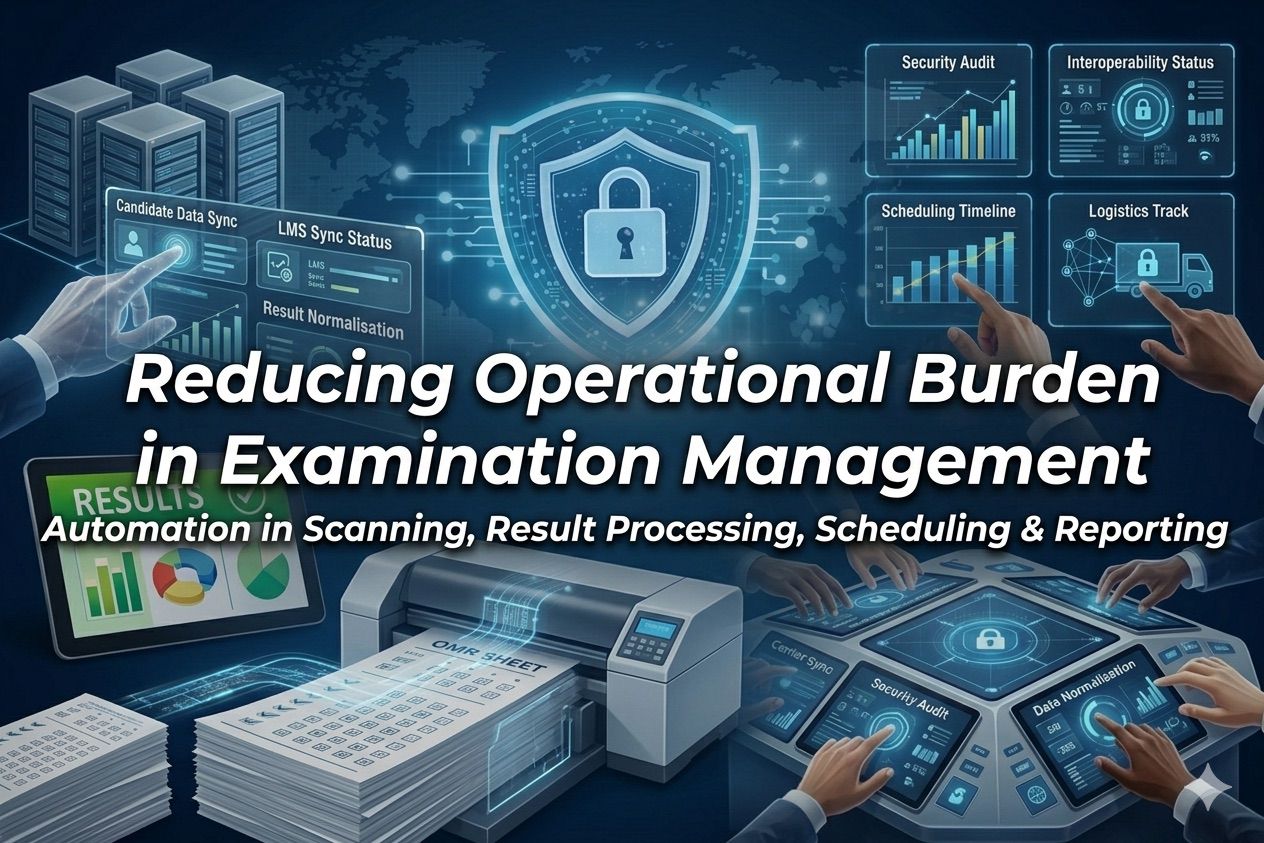
Today, examination management automation is no longer a futuristic concept; it is a fundamental requirement for institutional survival. By replacing fragmented, manual workflows with a unified digital core, organizations can shift their focus from managing paperwork to ensuring academic excellence. Automation does more than just speed up the process—it eliminates human error, reduces overhead costs, and fosters a level of transparency that manual systems simply cannot match.
The High Cost of Manual Examination Workflows
Operating an examination cycle manually involves a staggering amount of repetitive, high-stakes tasks. When these tasks rely on human intervention, the "cost" is measured in more than just currency :
Time Drain : Administrative staff spends hundreds of hours on data entry, manual sorting, and physical verification of OMR sheets.
Accuracy Risks : Manual result processing is prone to fatigue-driven errors, leading to incorrect grading and damaging legal disputes.
Security Gaps : Physical handling of sensitive exam materials at multiple stages increases the risk of leaks or unauthorized access.
Scalability Barriers : Manual systems fail when candidate numbers jump from thousands to millions, leading to system crashes and delayed timelines.
Streamlining Logistics with Exam Scheduling Automation
The first major hurdle in any assessment cycle is coordination. Managing thousands of candidates across hundreds of diverse testing centers requires a level of synchronization that spreadsheets cannot provide. This is where exam scheduling automation transforms the workflow.
Automated Center Allocation : Modern algorithms can now assign candidates to the nearest available testing center based on their geo-location. This reduces candidate travel time and ensures that no single center is over-capacity while others remain underutilized.
Digital Admit Card Generation : Provide candidates with context through "Spider Charts" or "Radar Graphs" that show their strengths relative to the entire cohort.
Resource and Invigilator Management : Scheduling software tracks the availability of invigilators, IT staff, and physical infrastructure in real-time. If a center becomes unavailable due to local issues, the system can re-route resources and notify candidates via automated SMS and email alerts within minutes.
Revolutionizing Data Entry via OMR Scanning Automation
The transition from a completed physical answer script to a digital data point is the most labor-intensive phase of traditional testing. However, OMR scanning automation has turned this multi-week ordeal into a high-speed, same-day process.
Industrial Speed : Modern OMR bureaus can process over 10,000 sheets per hour, allowing boards to digitize an entire city’s worth of data in a single shift.
Double-Data Verification : Automated scanners use dual-read technology to cross-verify every mark. If a candidate has made a faint mark or a smudge, the system flags it for human review rather than making a wrong guess.
Real-Time Data Sync : As sheets are scanned, the data is instantly encrypted and uploaded to a central server, eliminating the need for physical transport of sensitive mark sheets between offices.
Error Elimination : By removing the "data entry operator" from the equation, institutions eliminate the primary source of result discrepancies
The Power of Automated Result Processing
Once the data is digitized, the challenge shifts to evaluation. In a high-stakes environment, the pressure to declare results quickly is immense. Automated result processing allows institutions to meet these deadlines without compromising on quality.
1. Precise Merit List Generation
Automated engines apply complex marking schemes—including negative marking and weightage calculations—across millions of records in seconds. This ensures that the merit list is mathematically perfect and follows the pre-defined institutional criteria exactly.
2. Normalization and Statistical Scaling
For exams conducted over multiple shifts, "normalization" is essential to ensure fairness. Automation handles these complex statistical transformations (such as percentile-based scaling) instantly, ensuring that a candidate’s score is not unfairly impacted by the difficulty level of a specific shift.
3. Integration with Unified Platforms
By utilizing a comprehensive online examination system , institutions can link the scanning data directly to the result engine. This "End-to-End" flow means that as soon as the last OMR sheet is scanned, the final result is ready for a one-click audit and publication.
Advanced Reporting and Actionable Analytics
Reporting is the final, and perhaps most important, stage of the examination lifecycle. Modern education technology solutions have moved beyond simple "Pass/Fail" lists to provide deep, actionable insights.
Candidate-Specific Feedback : Automated systems generate detailed performance reports for every student, highlighting their strengths and weaknesses in specific subjects or cognitive areas.
Institutional Health Dashboards : Universities can view high-level data trends to see which colleges or regions are underperforming, allowing for targeted academic interventions.
Malpractice Detection Reports : Data analytics can flag "outlier" centers where scores are suspiciously high or identical, providing the evidence needed for a forensic audit.
Stakeholder Transparency : Results can be published via secure portals where candidates can view their scanned OMR copies alongside the official answer key, significantly reducing the number of RTI queries and re-evaluation requests.
Practical Impact: Why Schools and Universities Must Adapt
The shift toward automation is not just for national-level boards; it provides massive value to individual schools and universities as well.
Case Study : The Mid-Term Rush. A university managing mid-term exams for 50,000 students typically takes 30 days to release results. By adopting an automated workflow—from digital scheduling to OMR scanning—that timeline is reduced to 5 days. The administrative staff, previously buried in paper, is now free to focus on student counseling and curriculum development.
Cost Reduction : While there is an initial investment in technology, the "per-candidate cost" drops significantly. Institutions save on printing, physical logistics, manual labor, and the legal costs associated with correcting manual errors.
Conclusion: Building a Resilient Assessment Future
The traditional "pen-and-paper" mindset is rapidly becoming a liability in a world that demands speed, accuracy, and absolute security. Reducing the operational burden through examination management automation is the only way for institutions to maintain their credibility in the eyes of students and parents.
By integrating automated scheduling, high-speed scanning, and intelligent result processing, examination bodies can create a "frictionless" assessment journey. This transformation doesn't just make life easier for administrators; it ensures that every candidate is evaluated on a level playing field, backed by the precision of modern technology.
As we look toward the next decade of academic governance, the institutions that thrive will be those that view automation as an investment in their most valuable asset: their integrity. To learn more about modernizing your assessment infrastructure, you can explore our official blogs or contact us to consult with our technology experts.
About Us
India's Leading
EdTech Solution Provider
We don't just build tech — we build results.
Multigraphics Group builds scalable solutions across EdTech, training, software development, mobile apps, digital marketing, and exam tech.
We help institutions and businesses automate, digitize, and grow — using the systems and resources they already have.
-
 Simplify complex operations with custom-built tech
-
 Ensure growth through automation and smart digital tools
-
 Reach wider audiences with scalable online infrastructure